Jazz Noted
1927 · Swing / Big Band · New York

Duke Ellington at the Cotton Club

Ellington's residency at Harlem's Cotton Club — a whites-only venue with a Black cast — broadcasts jazz to the nation via radio.

Duke Ellington. Public domain, via Wikimedia Commons.

Duke Ellington's orchestra began its residency at the Cotton Club in December 1927. Nightly CBS radio broadcasts from the venue soon made Ellington a national household name. The arrangement was deeply contradictory: a Black band performing for exclusively white audiences in a venue that traded on racist 'jungle' imagery. Ellington navigated this with strategic brilliance, using the steady platform and paycheck to evolve his sophisticated compositional voice. This residency, lasting until 1931, transformed him from a local bandleader into one of America’s greatest composers.

Radio broadcasts from the Cotton Club made Ellington — and jazz itself — a national phenomenon.

Duke Ellington performing at the Hurricane Club, New York, 1943. By now Ellington had long outgrown the Cotton Club…
Duke Ellington performing at the Hurricane Club, New York, 1943. By now Ellington had long outgrown the Cotton Club, but his methods were the same — composing for the specific sound of each musician in his orchestra rather than writing generic parts. He didn't write for 'trumpet' — he wrote for Cootie Williams's growl, for Rex Stewart's half-valve technique. This approach, which he developed during those nightly Cotton Club sets, meant the Ellington orchestra was effectively an extension of his compositional mind. No other bandleader worked this way. The orchestra was his instrument.
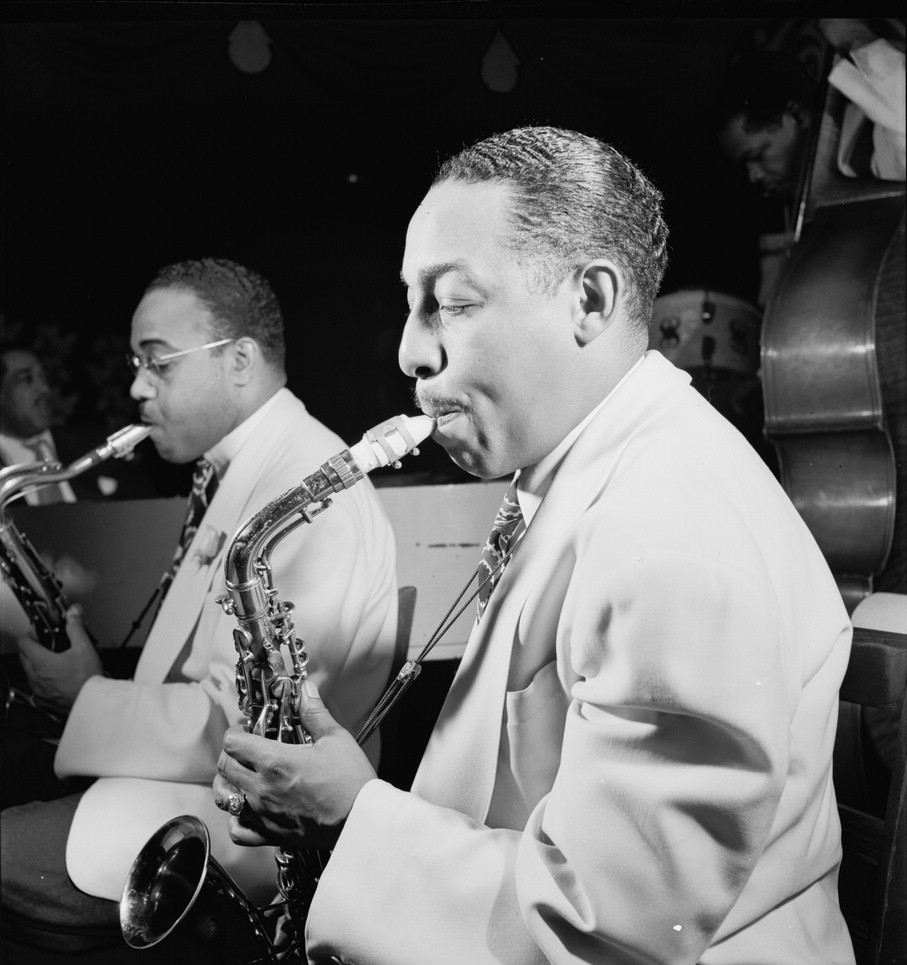
Johnny Hodges and Al Sears at the Aquarium, New York, ca. 1946. Hodges was Ellington's greatest soloist — his alto…
Johnny Hodges and Al Sears at the Aquarium, New York, ca. 1946. Hodges was Ellington's greatest soloist — his alto saxophone tone, liquid and aching, defined the sound of romantic longing in jazz. He joined Ellington's band in 1928, the year after the Cotton Club residency began, and stayed for most of the next four decades. Ellington composed specifically for that tone: 'Warm Valley,' 'Passion Flower,' and dozens of other pieces exist because Hodges was the man who would play them. When Hodges died in 1970, Ellington said simply, 'Never the biggest voice, the sweetest.'
Barney Bigard, 1947. The New Orleans-born clarinetist joined Ellington at the Cotton Club in 1927 and became one of…
Barney Bigard, 1947. The New Orleans-born clarinetist joined Ellington at the Cotton Club in 1927 and became one of the orchestra's most distinctive voices. His liquid, snaking clarinet lines gave pieces like 'Mood Indigo' their haunting, nocturnal quality. Bigard co-composed several Ellington standards, though the publishing credits, as was common in the era, went largely to Ellington. The Cotton Club residency was where Ellington learned to blend individual voices — Bigard's creole clarinet, Bubber Miley's growling trumpet, Tricky Sam Nanton's plunger-muted trombone — into textures that classical orchestrators couldn't imagine.
E. Simms Campbell's 'A Night-Club Map of Harlem,' published in Manhattan Magazine, 1932. This illustrated map captures…
E. Simms Campbell's 'A Night-Club Map of Harlem,' published in Manhattan Magazine, 1932. This illustrated map captures Harlem's nightlife ecosystem — the Cotton Club sits prominently on 142nd Street and Lenox Avenue. The map's playful tone belies the era's racial dynamics: most of these clubs served white audiences who traveled uptown for the thrill of Black entertainment, then went home. Ellington understood this arrangement perfectly and exploited it brilliantly. The Cotton Club made him famous; he made the Cotton Club historic. Within a few years he was performing at Carnegie Hall, the White House, and concert stages worldwide — far beyond any venue's claim on him.

Listen and read more

Open in the interactive timeline →

More from Swing / Big Band