Jazz Noted
1965 · Free Jazz / Avant-garde · New York

John Coltrane: 'A Love Supreme'

A four-part devotional suite recorded in one session. Coltrane's spiritual testament, composed after overcoming addiction.

John Coltrane, 1963.

Recorded in a single session on December 9, 1964 and released in 1965, 'A Love Supreme' was John Coltrane's spiritual autobiography — a four-movement suite expressing gratitude for his recovery from heroin and alcohol addiction and his relationship with God. The album transcended genre: it was jazz, prayer, and artistic manifesto simultaneously. It went on to sell over 500,000 copies — extraordinary for a deeply uncommercial, spiritually intense work. Coltrane would live only two more years, pushing further into the avant-garde. 'A Love Supreme' remains the point where jazz came closest to sacred music.

Jazz as spiritual practice. The most universally revered album in the post-bebop canon.

McCoy Tyner was only twenty-five when he recorded 'A Love Supreme,' but he had already spent four years as the…
McCoy Tyner was only twenty-five when he recorded 'A Love Supreme,' but he had already spent four years as the harmonic foundation of Coltrane's quartet. His left-hand voicings — built on stacked fourths rather than conventional triads — gave the group its vast, open sound, like sunlight coming through a cathedral window. On 'Resolution,' Tyner's piano comping drives Coltrane's solo forward with an almost orchestral intensity. He later said the quartet operated on an unspoken telepathy: 'We didn't need to rehearse. We just played.'
Elvin Jones was the engine of the classic quartet — a drummer who played in overlapping polyrhythmic waves rather than…
Elvin Jones was the engine of the classic quartet — a drummer who played in overlapping polyrhythmic waves rather than a steady backbeat, creating a sense of churning, oceanic momentum. On 'Pursuance,' the third movement of 'A Love Supreme,' Jones opens with an extended drum solo that is less a display of technique than a summoning — building from silence to a rolling thunder that pulls the entire band into the suite's climax. Jones once described playing with Coltrane as 'like being caught in a tornado. All you can do is hold on.'
Jimmy Garrison's four-note bass figure on 'Acknowledgement' is one of the most recognizable motifs in all of jazz — a…
Jimmy Garrison's four-note bass figure on 'Acknowledgement' is one of the most recognizable motifs in all of jazz — a hypnotic, mantra-like pattern that Coltrane then transposes through all twelve keys, as if to say that the divine is present in every tonality. Garrison was the quietest member of the quartet, but his deep, woody tone anchored everything. He had joined the group in 1962, replacing Reggie Workman, and stayed through the increasingly avant-garde final years. He died in 1976 at just forty-two, largely unsung compared to his bandmates.
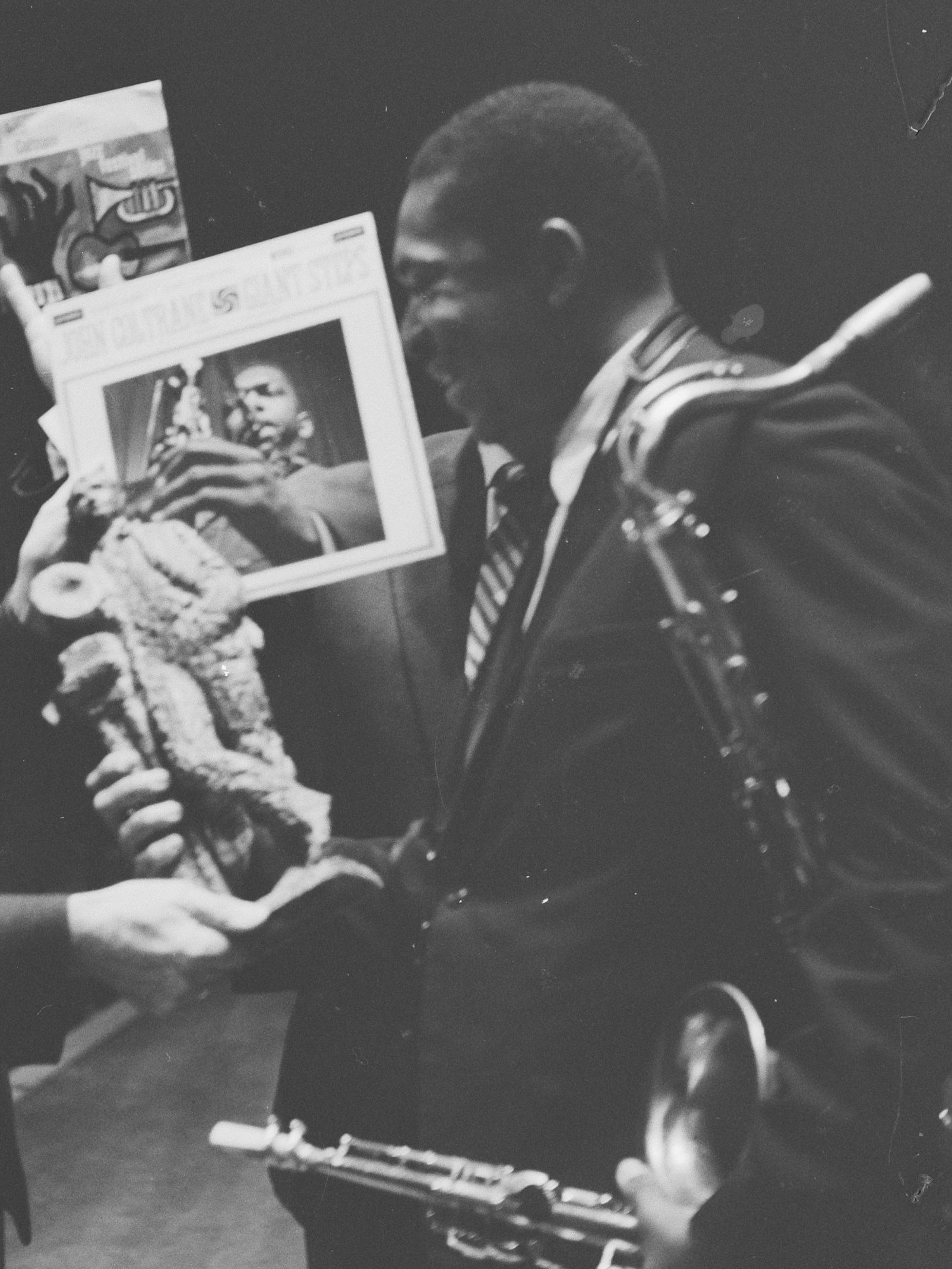
John Coltrane at the Concertgebouw in Amsterdam, November 1961, receiving the Edison Award for 'Giant Steps.' By late…
John Coltrane at the Concertgebouw in Amsterdam, November 1961, receiving the Edison Award for 'Giant Steps.' By late 1964, the quartet had been playing together for nearly four years — a rare stability in Coltrane's restless career. They tracked 'A Love Supreme' at Rudy Van Gelder's studio in Englewood Cliffs on December 9, 1964, in roughly four hours with the lights dimmed to a nightclub glow. The session was almost wordless. The next day, Coltrane returned with Archie Shepp on tenor and Art Davis on a second bass to re-record 'Acknowledgement,' but chose not to release that version. The issued album is pure quartet — and it became the rare avant-garde work that crossed over, eventually selling over half a million copies.

Listen and read more

Open in the interactive timeline →

More from Free Jazz / Avant-garde